Tuesday, November 24, 2009

Blog Entry VII - The Dunhuang Exchange

A prefecture and place of military importance, Dunhuang was a major point of cultural exchange during the Han and Tang dynasties. Dunhuang was accessible from both east and west on the Silk Road, and thus made it a primary stopover for pilgrims, merchants, and monks who were passing through the region. The variety of art and artifacts found at Dunhuang attests to the diversity of the people who made their way along the Silk Road at various times, from various places.

Buddhist masters and monks alike, from India and Central Asia, often stopped at Dunhuang while travelling to the Chinese capital of Chang'an. The abundance of painted caves and illuminated manuscripts made it an ideal place for Buddhists to meditate, read, or learn about Chinese culture before entering the capital. It was a Buddhist epicentre that provided temples, gardens, and lecture halls for anyone who desired to utilize them, and as such, Dunhuang was a thriving monastic community.

Frescoe from one of the Mogao Caves at Dunhuang. Preservation of these frescoes is of utmost priority, with visitors from all around the world who come to Dunhuang to view them.

Tuesday, November 10, 2009

Blog Entry VI - Parallels in Buddhism and Christianity

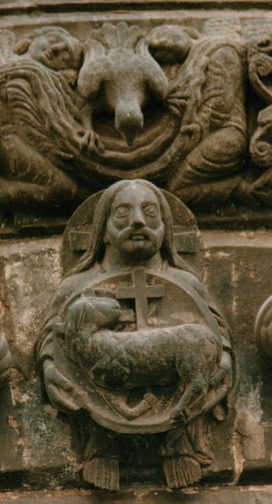
Thematic parallels among religions are consistently evident. For example, the fundamental themes of typology, purity, and morality that are found in Zoroastrianism are found also in the three major religions of Christianity, Judaism, and Islam. Following the reading there was nothing that inspired me to write an entry immediately. Suddenly, I just thought it would be interesting to look into possible parallels, obvious ones perhaps, between Buddhism and other religions, as following the thematic form of my previous entry, entitled "A Thematic Approach to Zoroaster’s Gathas". The parallel I’d like to point out, with no solid scholarly proof but merely opinion, is the possible link between the Holy Trinity in Christianity and the Three Jewels in Buddhism. It’s not necessarily that one was derived essentially from another as a carbon copy, but the concepts in themselves, rather, what the Holy Trinity means to Christianity, and what the Three Jewels means to Buddhism, are similar in their function and their meaning to each religion.

In Buddhism and Christianity, the counterparts of the Three Jewels and the Holy Trinity are not more important than the other, but the counterparts form one cohesive unit that cannot exist without the individual counterparts. The three counterparts in each respective religion form what could be interpreted as emanations of a greater “godhead”, or the entity in it's entirety. From a most rudimentary approach, let’s take a look at the actual names, representations, and parallels of the figures within the Three Jewels and the Holy Trinity. The Father, and the Buddha, the Son and the Dharma, the Holy Ghost and the Sangha, respectively.

First let’s focus on the parallels between the purpose of the Father, and the purpose of the Buddha. Both the “father” and “Buddha” are actual representations of a “person,” but also metaphorical, as well as metaphysical representations of the concept of someone more divine than us unenlightened ones. Second, let’s look at the parallels between the purpose of the Son, and the Dharma. The son was the “person”, or concept, that diffused the ways and doctrines of the overall “religion.” The son and the Dharma are the constructs of the father, or rather, the father and Buddha were the vehicles for wisdom to be diffused through the Son and the Dharma upon the less enlightened ones. The son and Dharma could also connote “the ultimate and sustaining reality which is inseperable from the Buddha.” Just as the Son is the real, tangeable representation that is inseperable from the Father. Third, we have the Holy Ghost and Sangha. The Holy Ghost is how access to enlightenment is gained within the entire entity. We gain access to the Son through his Holy Ghost, and through the Son we gain access to the Father. The Holy Trinity and the Three Jewels are individual, but cannot exist without one another and therefore represent a whole “experience” within each religion.

Relief depicting "The Holy Trinity", Basilique Saint-Denis in Paris, exact date and artist unknown.


Sculpture, or possibly a relief of "The Three Jewels" or "The Three Refuges", exact date and artist unknown.

Monday, November 2, 2009

Blog Entry V - A Thematic Approach to Zoroaster's Gathas

Founded in approximately 1,000 BCE by Zoroaster—also known as Zoroastra, or Zarathustra—Zoroastrianism comprises his philosophical and ethical wisdom as preserved in his Gathas, or hymns, written in Avestan, which is said to be a sister language to Sanskrit. Zoroastrianism was at one time the dominant faith of the Persian Empire, and today it maintains significance as the smallest major religion in the world. As Mary Boyce explains; “Zoroastrianism is the oldest of the revealed world religions, and it has probably had more influence on mankind, directly and indirectly, than any other single faith.”

Zoroaster was the first known person to interpret and teach the doctrines of light and dark as metaphors for truth and falsehood, “heaven and hell”, the “last judgment”, and the “everlasting” states of the reunited mind, body, and soul. These doctrines—which for the purpose of this blog I prefer to call concepts—became recognizable and significant interpretations of faith to much of mankind, evidently inspiring Judaism, Christianity, and Islam.

The themes in the Gathas have inspired themes in the world’s three major religions, and even a rudimentary understanding of any of the three faiths will prompt immediate recognition of the great similarities in the fundamental themes of these religions and the fundamental themes of Zoroastrianism. In the Torah, the Bible, and the Qur’an, most general messages, doctrines, concepts and so forth revolve around the themes of good and evil, cleanliness and impurity, righteousness and wickedness, life and the afterlife—that constitute the teachings underlined in the Gathas.

Even routine practices, still implemented currently, seem to be inspired by practices explained in the Gathas, and there are two examples which immediately came to my mind while reading the course material. Firstly, in the Jewish faith, one cannot blow out a lit flame, but rather let it burn until the flame dies out naturally. Secondly, in the Muslim faith, one must wash before entering a place of worship, and before beginning prayer. I had never realized the overwhelming significance of Zoroastrianism before…!

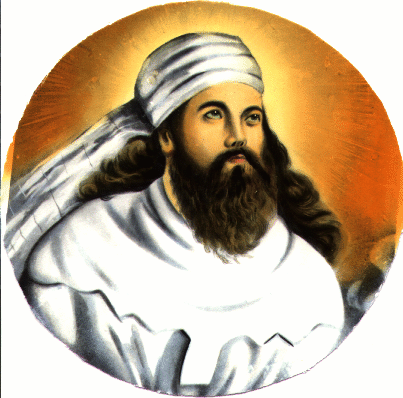
Interpretive image of Zoroaster. Dare I say, note the similarity between this image of Zoroaster and the modern image of Christ?


Monday, October 26, 2009

Blog Entry IV - On Religion...

Religion, I think, is a subjective name given to classify shared systems of thought that include narratives, symbols, values and applications that comprise what individuals interpret as an overall experience. Religion should not exclusively study the ways in which people express their religion, but rather should study why people express religion in these ways and what their religious experiences mean to them. Until recently, anthropologists have focused on particular stories, icons, and rituals, and how culture affects them, how they affect culture, and how they compare to the religions of other cultures. This method of inquiry is limited similarly in the way that ethnographic writing is limited, not taking into account the individual members of particular cultures, and religions in this case, and what and why they believe, think, and feel.

For two centuries, anthropologists attempted to define religion by separating societies and cultures into those that were civilized and those that were uncivilized, and used religion as a primary means to measure the level of advancement a particular society or culture displayed, and their advancement was accordingly demonstrated by the complexity of their religion. Anthropologists compared the spheres of “Western” religions to “non-Western” religions, as they similarly compared the relative intricacy and progression of “Western” and “non-Western” spheres of thought. Until the mid-twentieth century, anthropology and the study of religion endured a conceptual polarity between “primitive” and “civilized” modes of thought and inquiry. As in Edward Said’s “Orientalism”, scholars were constantly attempting to make comparative analysis based on the comparison of “Us” and “Them,” and on the Silk Road, anthropological concepts were derived from the ethnographic accounts of explorers and missionaries who originated from clear-cut religious traditions, and these accounts were assessed by scholars whose concepts were shaped by the same clear-cut religious traditions.

Current studies of religion still struggle to overcome the biases that anthropologists of religion established throughout two centuries of study, but current anthropologists have realized that the focus of their study should not be a comparison of religions and cultures, but to the way that religion is experienced by people as individuals, and how these individual people express religious experience. This idea is appropriately summarized as follows: “An important concept in the study of religion is that anthropologists fail to take religion seriously, and hence no matter their level of methodological sophistication, they simply cannot fully understand and appreciate the experience of people for whom religious experiences are real.”

Monday, October 19, 2009

Blog Entry III - A Glimpse of Sogdian Art

The Sogdians became prominent as traveling merchants subsequent to the domination of Alexander the Great, maintaining a crucial position both culturally and geographically on the Silk Road. They ruled the trading economy across the Silk Road from the 2nd century BCE until the 10th century. Their language became the lingua franca of the Silk Road, which was important not only to the propagation of Buddhism, Manichaeism, and Zoroastrianism, but to the diffusion of art!

Most sites where Sogdian art has been recovered are in modern Uzbekistan and northwestern Tajikistan. This location allowed for the infusion of various influences ranging from western, Hellenistic-style art to southeastern, Buddhist-style art. The amalgamation of techniques from such diverse sources coupled with a local ingenuity inspired a rich artistic culture that was the symbol of Central Asian art at it's finest. The Sogdians were the first Central Asian people to display technique and style of unprecedented caliber in their murals, paintings, sculptures, woodwork and gilding. There art was diverse in it's sources, but more importantly, Sogdian art made its way across an entire continent; penetrating almost as far west as it did east.

Identifiable for its varied characteristics, the art of Sogdiana is most recognizable for influencing the art of other cultures! Their location on the Silk Road made it possible for the unassuaged transmission of artistic techniques across space and time. Geographically, influences of Sogdiana have been recorded all throughout Central Asia and north into the steppes, south into the Arabian Peninsula, east across the Taklamakan through to central China and as far west as the Balkans and the rest of Southern Europe. Historically, and geographically correlated, influences have been recorded from the end of the Early Christian Period until the beginning of the Byzantine Period. (Prior to researching Sogdiana, I wouldn't have fathomed the breadth of importance their art possessed!)

According to archaeologists and anthropologists alike, the 6th century was the pinnacle of Sogdian culture, and also when they flourished with artistic tradition. Appreciable amounts of temporal and religious pottery and sculptures were discovered at Samarkand, the best examples dating from before the Hellenistic period in the mid 3rd century BCE, to the Muslim conquests of Persia in the mid 6th century.

Some of the most revealing of these Samarkand finds include statuettes of women that characterize Zoroastrian deities like Anahita, revered as the deity of water and fertility (all the figures hold a piece of fruit, a symbol of fertility in terms of childbearing and of trade). It’s interesting to note that, in comparison to the discovery of other similar statuettes, Anahita was the most frequently discovered, which implies that water and fertility were very important in the everyday life of Sogdians.

Sogdian art frequently reflected the routine and banal, but it's style was often whimsical. For example, there were several benches recovered from Bukhara that displayed murals and paintings depicting processions of various animals that were escorted by elaborately clad hunters seated on elephants, chased by leopards and griffins (neither native to Sogdiana). Scenes of sportive pursuit such as these were popular in Sogdian art, and were often depicted on wooden shields painted with figures of riders mounted on festively decorated horses, wearing hunting robes donned with knives, bows, and a quivers of arrows. This theme is thought to have influenced the style of book illumination in Islamic Persian art following the Muslim conquests of Persia.

Sogdian art reflected what was important to them as people and as a culture. Their art portrayed their strong beliefs, both religious and temporal. What was more significant than their refined techniques and vibrant style was their capability to transmit these aspects liberally. Their prominence as merchants and strength as a culture made the diffusion of their art possible then, and admired now.

Sogdian mural recovered at Bukhara, exemplifying the style that would later influence Islamic Persian art. Note the rich colours, flowing lines and well defined features.

Tuesday, September 22, 2009

Blog Entry I - Reflections of the Silk Road

When initially contemplating the Silk Road, I, like so many others, romantically envisioned deserts, plains and mountains covering limitless distances, traversed by men and beasts as rugged as the topography; expeditions of merchants and archaeologists transporting precious cargo from east to west and back again, all in the name of accolade and profit. I admit my ignorance in not taking the time to consider that there was more to the Silk Road than it's economic uses; failing to recognize the amalgamation and separation of religions, art and architecture techniques, literature and language, not to mention the blending of the people themselves.

Upon reading Wood's "The Silk Road: Two Thousand Years in the Heart of Asia" I was able to expand my existing knowledge of the Silk Road by linking names, dates and places that were already familiar to me, to form a solid backdrop for the Silk Road. The Silk Road became a more tangible time; from the Han Dynasty of the 2nd century B.C.E. to the Age of Industrialization in the 18th century A.D., and too, became a more tangible place; from China and Mongolia, to India, Iraq and Iran, through to present day Kazakhstan, Tajikistan and the other former Soviet states, Afghanistan and Turkey, until Rome and the rest of Europe.

Almost immediately, it was no longer difficult to picture the arduous journey from Chang'an to Kashgar, north or south through the treacherous Taklamakan, the hostile mountain ranges of Pamir and Hindukush, through endless barren landscapes in Balkh and Merv, and finally to Rome; the epicenter of Europe, and the conquerors and explorers, from Alexander the Great to Aurel Stein, who traversed these places for personal and grand gains alike, despite bandits, wolves and lethal sandstorms, blizzards and droughts.

Due to its cultural and religious mosaics, the beauty of the land and the luxury of the goods it produced, the joining of people so far apart, their ideas of one another and how it affected their relations, their ability to share language, art, and music,
the Silk Road retains a form of romanticism despite the very real history behind it. In relation to the music of the Silk Road, I've included a video featuring Yo-Yo Ma's "The Silk Road Project" (which I was fortunate to have seen recently when the tour came through Toronto). While listening to the music, you can pick out various instruments from different places along the Silk Road, and envision the musicians who played their pieces for audiences very far from their homes and perhaps very far from the roots of their own culture. The piece is a perfect, modern interpretation of how the cultures of the Silk Road shared common interests.

Yo-Yo Ma's "The Silk Road Project" - an excerpt from the Lincoln Center, live in New York City.

http://www.youtube.com/watch?v=i08x6OeqC3Y