Thematic parallels among religions are consistently evident. For example, the fundamental themes of typology, purity, and morality that are found in Zoroastrianism are found also in the three major religions of Christianity, Judaism, and Islam. Following the reading there was nothing that inspired me to write an entry immediately. Suddenly, I just thought it would be interesting to look into possible parallels, obvious ones perhaps, between Buddhism and other religions, as following the thematic form of my previous entry, entitled "A Thematic Approach to Zoroaster’s Gathas". The parallel I’d like to point out, with no solid scholarly proof but merely opinion, is the possible link between the Holy Trinity in Christianity and the Three Jewels in Buddhism. It’s not necessarily that one was derived essentially from another as a carbon copy, but the concepts in themselves, rather, what the Holy Trinity means to Christianity, and what the Three Jewels means to Buddhism, are similar in their function and their meaning to each religion.
In Buddhism and Christianity, the counterparts of the Three Jewels and the Holy Trinity are not more important than the other, but the counterparts form one cohesive unit that cannot exist without the individual counterparts. The three counterparts in each respective religion form what could be interpreted as emanations of a greater “godhead”, or the entity in it's entirety. From a most rudimentary approach, let’s take a look at the actual names, representations, and parallels of the figures within the Three Jewels and the Holy Trinity. The Father, and the Buddha, the Son and the Dharma, the Holy Ghost and the Sangha, respectively.
First let’s focus on the parallels between the purpose of the Father, and the purpose of the Buddha. Both the “father” and “Buddha” are actual representations of a “person,” but also metaphorical, as well as metaphysical representations of the concept of someone more divine than us unenlightened ones. Second, let’s look at the parallels between the purpose of the Son, and the Dharma. The son was the “person”, or concept, that diffused the ways and doctrines of the overall “religion.” The son and the Dharma are the constructs of the father, or rather, the father and Buddha were the vehicles for wisdom to be diffused through the Son and the Dharma upon the less enlightened ones. The son and Dharma could also connote “the ultimate and sustaining reality which is inseperable from the Buddha.” Just as the Son is the real, tangeable representation that is inseperable from the Father. Third, we have the Holy Ghost and Sangha. The Holy Ghost is how access to enlightenment is gained within the entire entity. We gain access to the Son through his Holy Ghost, and through the Son we gain access to the Father. The Holy Trinity and the Three Jewels are individual, but cannot exist without one another and therefore represent a whole “experience” within each religion.
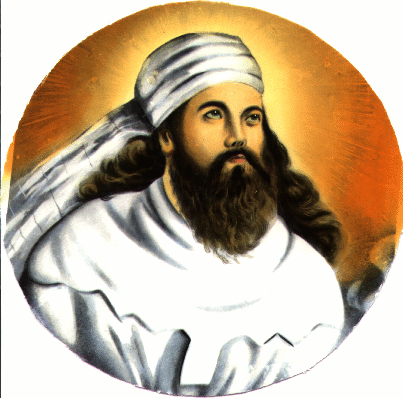
Relief depicting "The Holy Trinity", Basilique Saint-Denis in Paris, exact date and artist unknown. 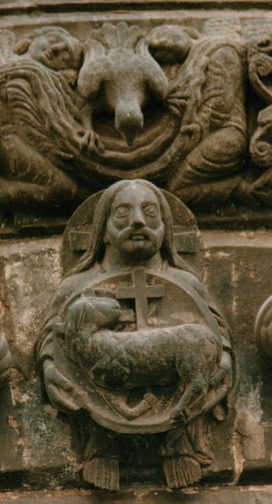 Sculpture, or possibly a relief of "The Three Jewels" or "The Three Refuges", exact date and artist unknown.